Table of Contents
This post contains Amazon affiliate links. As an Amazon Associate, we earn from qualifying purchases, at no extra cost to you.
Potty training feels like the first real test of puppy ownership, and it is easy to assume something has gone wrong when accidents keep happening in week two. In most cases nothing has gone wrong at all. Puppies learn bladder control gradually, and the process is far more about your schedule and supervision than about correcting the puppy.
Why Potty Training Takes Longer Than You Expect
A puppy’s bladder is small and their control over it develops slowly. A commonly used rule of thumb is that a puppy can hold their bladder for roughly one hour per month of age, up to about eight hours as an adult. A three-month-old puppy, in other words, may genuinely need a bathroom break every three hours, even overnight. Accidents are not a sign of stubbornness or a training failure; they are a normal part of a young body still developing control.
Understanding this timeline changes how you respond to mistakes. Instead of asking “why isn’t this working,” the more useful question is “was I actually there to prevent it, or to reward the right choice?” Potty training success is driven almost entirely by how well you manage the schedule and the environment, not by how firmly you react to accidents.
Setting Up a Consistent Schedule
Puppies thrive on predictability. A consistent schedule for meals, water, play, and naps makes their bathroom needs predictable too, which is what allows you to get them outside at the right moment instead of guessing.
- Take your puppy out first thing in the morning, before anything else.
- Take them out again within 5 to 10 minutes of eating or drinking.
- Add a bathroom break after every nap, every play session, and before bedtime.
- Use the same door and the same general spot in the yard each time, so the location itself becomes a cue.
Feeding on a fixed schedule, rather than leaving food out all day, makes elimination far more predictable as well, since what goes in on a schedule tends to come out on a schedule.
Recognizing the Signs Your Puppy Needs to Go
Most puppies give a warning before an accident, even if it is subtle. Common signs include circling, sniffing the floor with more intent than usual, suddenly stopping play, whining, or heading toward a door or a previously used spot. The challenge is that these signs can appear and pass within seconds, which is why close supervision matters so much in the first few weeks.
When you cannot supervise directly, use a crate, a playpen, or a leash tethered to you (sometimes called “umbilical cord” training) to prevent your puppy from wandering out of sight and having an accident you did not see coming.
What to Do When Accidents Happen
If you catch your puppy in the act, interrupt calmly with a neutral sound and immediately walk them outside to finish. Praise warmly the moment they finish outside. If you find a mess after the fact, simply clean it up. Scolding a puppy after the fact does not connect the correction to the behavior; it only teaches them that your presence near a mess is unpredictable, which can actually make them hide when they need to go.
Clean accidents with an enzymatic cleaner rather than a standard household cleaner. Enzymatic cleaners break down the odor-causing compounds in urine completely, while regular cleaners can leave a residual scent that draws the puppy back to the same spot.
Crate Training as a Potty Training Tool
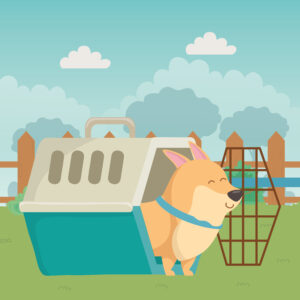
A properly sized crate is one of the most effective potty training tools available, because most dogs have a strong instinct not to soil the space where they sleep. The crate should be just large enough for your puppy to stand, turn around, and lie down comfortably. A crate that is too large removes this natural incentive, since the puppy can eliminate in one corner and sleep in another.
Never use the crate as punishment. It should be introduced gradually and paired with positive associations like meals, chew toys, and quiet rest, so your puppy sees it as a safe den rather than a consequence.
Sample Daily Schedule by Age
For an 8 to 10 week old puppy, plan on a bathroom break roughly every 1.5 to 2 hours during the day, plus immediately after every meal, nap, and play session, and once more in the middle of the night if needed. By 4 to 5 months, most puppies can comfortably stretch to every 3 to 4 hours during the day. By 6 months and beyond, many puppies can hold it for 4 to 6 hours, though every dog develops at a slightly different pace.
Consistency over the first two to three months matters far more than any single correction or reward. Puppies who are taken out often enough to succeed, and praised clearly when they do, typically become reliably house-trained well before their first birthday.